
Strength Training After 40: A Beginner's Guide
Key Takeaways
- Muscle mass declines gradually with age — research reviewed in the National Library of Medicine describes a loss of approximately 3–8% per decade after age 30, accelerating after 60 (Source: National Center for Biotechnology Information, https://pmc.ncbi.nlm.nih.gov/articles/PMC2804956/).
- The World Health Organization recommends muscle-strengthening activities involving all major muscle groups on 2 or more days per week, alongside aerobic activity (Source: World Health Organization, https://www.who.int/europe/news-room/fact-sheets/item/physical-activity).
- Beginners do best with light loads, good form, full-body sessions, and rest days between sessions — progression should be gradual, not rushed.
- A simple 2–3 day weekly routine built on basic movement patterns (squat, hinge, push, pull, and core) covers the whole body without requiring a gym.
- Persistent pain, dizziness, or a known medical condition are reasons to get professional guidance before starting, not reasons to push through.
Why Muscle Matters More After 40
Turning 40 does not suddenly make you frail, but it does mark the point where a slow, quiet process deserves your attention. The involuntary loss of muscle mass, strength, and function with aging is called sarcopenia.
That matters for everyday life, not just for athletic performance. Muscle is what lets you carry groceries, climb stairs, get up from a low chair, and catch yourself if you trip. The same review links the loss of muscle mass and strength to a higher risk of falls, vulnerability to injury, and functional dependence in older age (Source: National Center for Biotechnology Information, https://pmc.ncbi.nlm.nih.gov/articles/PMC2804956/). In other words, strength is a practical asset: it protects your independence.
The encouraging part is that muscle responds to training at any age. Strength training — also called resistance training — means working your muscles against a force: your own body weight, resistance bands, dumbbells, or machines. It is one of the few interventions with broad support for maintaining muscle and function as you age, and it is also one of the most accessible. You do not need to become a bodybuilder, and you do not need to have started young. You only need a sensible starting point and a routine you can actually keep.
What the Guidelines Actually Say
If you are wondering how much strength training is "enough," public health guidelines give a clear, modest answer. The World Health Organization recommends that adults do muscle-strengthening activities at moderate or greater intensity, involving all major muscle groups, on 2 or more days per week, as these provide additional health benefits beyond aerobic activity (Source: World Health Organization, https://www.who.int/europe/news-room/fact-sheets/item/physical-activity).
That strength work sits alongside the WHO's aerobic recommendation: at least 150 minutes of moderate-intensity activity per week, or 75 minutes of vigorous activity, or an equivalent combination (Source: World Health Organization, https://www.who.int/initiatives/behealthy/physical-activity). Brisk walking, cycling, and swimming all count toward the aerobic side. For adults aged 65 and older, the WHO adds varied multicomponent activity that emphasizes functional balance and strength training on 3 or more days a week, to enhance functional capacity and prevent falls (Source: World Health Organization, https://www.who.int/europe/news-room/fact-sheets/item/physical-activity).
Two days a week is the key number for a beginner. It is enough to build a habit and to make progress, and it leaves plenty of recovery time. Many beginners start with two full-body sessions per week, then add a third session later if they enjoy it and recover well. There is no requirement to train five or six days a week, and for someone just starting out, more is often worse: it raises the risk of soreness, burnout, and injury before the habit has a chance to form.
Safe Starting Principles
Starting strength training after 40 is mostly about respecting a few principles. They are simple, but they make the difference between a routine that lasts and one that ends in frustration.
Start lighter than you think you need to. Your first sessions are for learning movements, not testing limits. Choose weights you can lift with good control for the full set, leaving a few repetitions "in the tank." If the last repetitions of a set look sloppy, the weight is too heavy for now.
Learn form before adding load. The basic patterns — squatting, hinging at the hips, pushing, pulling, and bracing the core — are worth learning properly. Slow, controlled repetitions teach your body the movement far better than fast, heavy ones. A few sessions with a qualified trainer, or reputable instructional videos from certified coaches, can be a worthwhile investment at the start.
Train the whole body each session. A full-body session covers legs, back, chest, arms, and core in one visit. For a beginner training two or three times per week, this is more effective than splitting the body into separate days, because each muscle group gets trained more often.
Rest between sessions. Muscles adapt during recovery, not during the workout itself. Leave at least one rest day between strength sessions, and more if you are still very sore. Soreness in the first weeks is normal — it is your body's response to a new stimulus — but it should fade as you adapt.
Progress gradually. The standard approach is to add a small amount of weight, or a repetition or two, only when the current load feels comfortable for all sets with good form. Small, steady increases compound over months. There is no deadline, and no one is keeping score except you.
Warm up every time. Five to ten minutes of light movement — walking, gentle cycling, or easy body-weight movements — followed by a few light sets of the first exercise prepares joints and muscles and helps you practice the movement before the working sets.
A Simple 2–3 Day Beginner Routine
The routine below is a general educational outline, not a personal prescription. It shows the shape of a beginner program: two alternating full-body days, each built on basic movement patterns, with a rest day between sessions.
Day A
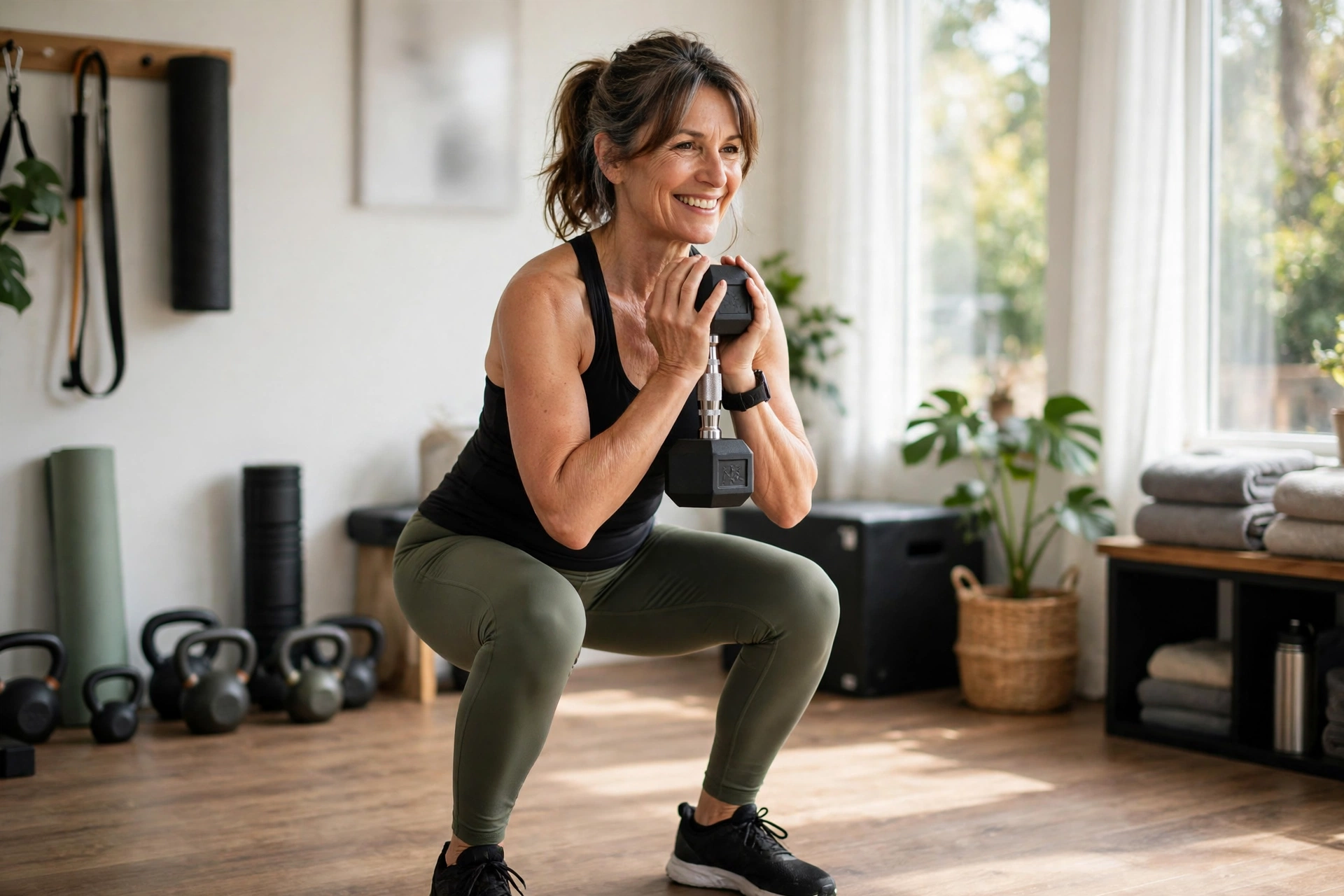
- Goblet squat (squat pattern) — 2–3 sets of 8–10 repetitions
- Dumbbell or band row (pull) — 2–3 sets of 8–10 repetitions
- Push-up or knee push-up (push) — 2–3 sets of as many good repetitions as you can manage
- Glute bridge (hinge and hip strength) — 2–3 sets of 10–12 repetitions
- Dead bug or plank (core) — 2–3 sets of 20–30 seconds
Day B
- Romanian deadlift with light dumbbells (hinge pattern) — 2–3 sets of 8–10 repetitions
- Overhead press with dumbbells (push) — 2–3 sets of 8–10 repetitions
- Lat pulldown or band pull-apart (pull) — 2–3 sets of 10–12 repetitions
- Step-up onto a low platform (single-leg strength and balance) — 2–3 sets of 8 repetitions per side
- Side plank (core) — 2–3 sets of 15–20 seconds per side
A week might look like Day A on Monday, Day B on Thursday, and an optional repeat of Day A on Saturday once you feel ready. Each session, including warm-up, takes roughly 30–45 minutes. No gym is required: dumbbells and resistance bands at home cover every movement above, and body weight alone is a legitimate starting point.
Two cautions apply. First, these are general ranges for healthy beginners, not targets you must hit. If an exercise hurts — sharp pain, joint pain, or pain that changes how you move — stop and reassess rather than finishing the set. Second, if you have a medical condition, a previous injury, or you take medication that affects your heart, blood pressure, or balance, talk to a healthcare professional before beginning.
Form and Recovery Basics
Good form is not about looking impressive; it is about keeping the load where it belongs. A few cues cover most beginner mistakes: keep your spine in a neutral position rather than rounded or arched excessively, breathe out on the effort and in on the release (never hold your breath through a heavy lift), move through a range you control, and keep knees tracking in line with your toes during squats and step-ups.
Recovery deserves as much attention as the workout. The basics are unglamorous but effective: sleep enough, eat regular balanced meals, and stay hydrated. Protein also plays a supporting role in muscle maintenance. A review on dietary protein and aging proposed that older adults aim for a sufficient amount of protein with each meal — around 25–30 grams of high-quality protein per meal — to support muscle protein synthesis (Source: National Center for Biotechnology Information, https://pmc.ncbi.nlm.nih.gov/articles/PMC2760315/). You do not need to obsess over exact numbers; including a protein-rich food at each meal — eggs, fish, poultry, beans, lentils, tofu, or yogurt — is a practical way to apply the idea.
Soreness deserves a brief note. Mild muscle soreness a day or two after a new workout is common and usually fades within a few days. Pain that is sharp, one-sided, located in a joint, or still worsening after several days is different — that is a signal to rest and, if it persists, to seek professional advice.
Common Beginner Mistakes
Watch for these patterns — they are the fastest way to stall progress or invite injury:
- Too much, too soon. Adding weight before form is solid. Rule of thumb: if you cannot complete the target repetitions with good form, the load is too heavy.
- Skipping warm-ups. Five to ten minutes of easy movement — brisk walking, arm circles, leg swings, bodyweight squats — raises tissue temperature and lowers injury risk.
- Ignoring recovery. Training the same muscles hard on consecutive days leaves no window for adaptation. Beginners need those rest days.
- Copying advanced lifters. A program designed for someone with five years of experience is not a beginner program. Yours should look boring by comparison.
When to Seek Professional Guidance
A qualified coach or physical therapist is worth consulting when any of the following apply:
- You have a heart condition, high blood pressure, diabetes, or another chronic illness.
- You take medication that affects heart rate, blood pressure, balance, or bone density.
- You are recovering from an injury or surgery.
- You experience chest pain, dizziness, or faintness during or after exercise.
- You have persistent joint pain that does not improve with rest and form corrections.
None of this should be read as medical advice. It is general information to help you ask better questions — of a coach, a clinician, or yourself before your next session.
Frequently Asked Questions
Is it safe to start lifting weights after 40 with no experience?
For most healthy adults, yes — starting with light loads, learning good form, and progressing gradually is a well-established approach. If you have a medical condition or take relevant medication, check with a clinician first.
How many days per week should a beginner train?
Two to three full-body sessions per week, with at least one rest day between them, is enough for most beginners to make steady progress.
Do I need a gym membership to get started?
No. Dumbbells, resistance bands, and bodyweight exercises can cover every movement pattern in the routine above. A gym becomes useful later if you want heavier loads or machines.
How long until I see results?
Strength improves first — often within a few weeks — because early gains come mostly from your nervous system learning the movements. Visible muscle change typically takes a couple of months of consistent training.
What should I eat around my workouts?
Have a normal balanced meal a few hours before, or a light snack an hour or so prior if you train soon after eating. Afterward, eat a regular meal containing protein within a few hours — precise nutrient timing matters far less than consistent daily nutrition.
This article is for general educational purposes only and is not medical advice. If you have a health condition, take medication, or experience concerning symptoms, consult a qualified healthcare professional before starting or changing an exercise program.
By Putri PD