
Osteoporosis: 7 Early Signs, Causes, and How to Prevent It

Key Takeaways
- Osteoporosis is the "silent disease" — bones weaken without symptoms until a fracture occurs.
- Early signs: loss of height, stooped posture, back pain, fractures from minor falls, weakened grip, receding gums.
- Women at higher risk — estrogen protects bone density and drops sharply after menopause.
- Four prevention pillars: calcium, vitamin D, weight-bearing exercise, avoiding smoking/heavy drinking.
- DEXA scan is the gold standard — painless, 10 minutes, shows exactly where you stand.
Your bones could be weakening right now and you'd have no idea. That's osteoporosis — it thins bones year after year until a simple misstep becomes a life-changing fracture. Good news: it's one of the most preventable conditions. Same habits that protect bones — eating well, moving, sunshine — are nothing exotic.
This article is for informational purposes only and is not medical advice. Screening decisions should be made with your healthcare provider.
What Is Osteoporosis?
Think of bones as a living savings account. You build bone until peak mass in your late 20s–30s, then breakdown slowly outpaces rebuilding. Osteoporosis is when that deficit becomes dangerous — the honeycomb bone structure thins until ordinary activities (bending, coughing, minor falls) cause fractures. Most common: hip, spine, wrist. You can't feel bones thinning — hence "silent disease."
What Are the 7 Early Signs of Osteoporosis?
- Getting shorter — vertebrae develop tiny compression fractures; losing an inch+ is a red flag.
- Changing posture — stooping/hunched back as vertebrae compress.
- Back pain that won't quit — from micro-fractures in the spine.
- Fractures from minor falls — breaking a bone from standing-height fall.
- Weakened grip strength — linked to overall bone fragility.
- Receding gums — jawbone loss can loosen teeth.
- Brittle nails — not diagnostic alone, but part of the picture.
Why Are Women at Higher Risk?
Estrogen protects bone density. After menopause, estrogen drops sharply and bone loss accelerates — women can lose up to 20% of bone density in the 5–7 years after menopause. That's why screening guidelines start earlier for women (65 vs 70 for men).
What Are the Major Risk Factors?
| Risk factor | Why it matters |
|---|---|
| Age (50+) | Bone breakdown outpaces rebuilding |
| Female / early menopause | Estrogen loss accelerates bone loss |
| Family history | Genetics influence peak bone mass |
| Low body weight | Less bone to lose; less loading stimulus |
| Smoking | Impairs bone formation |
| Heavy alcohol | Interferes with calcium balance |
| Long-term steroids | Accelerate bone breakdown |
| Sedentary lifestyle | Bones need loading to stay strong |
How Is Osteoporosis Diagnosed?
DEXA scan — the gold standard. Painless, about 10 minutes, low radiation. Measures bone mineral density at hip and spine, reported as a T-score: above -1.0 normal, -1.0 to -2.5 osteopenia (low bone mass), -2.5 or below osteoporosis.
How Can You Prevent Osteoporosis?
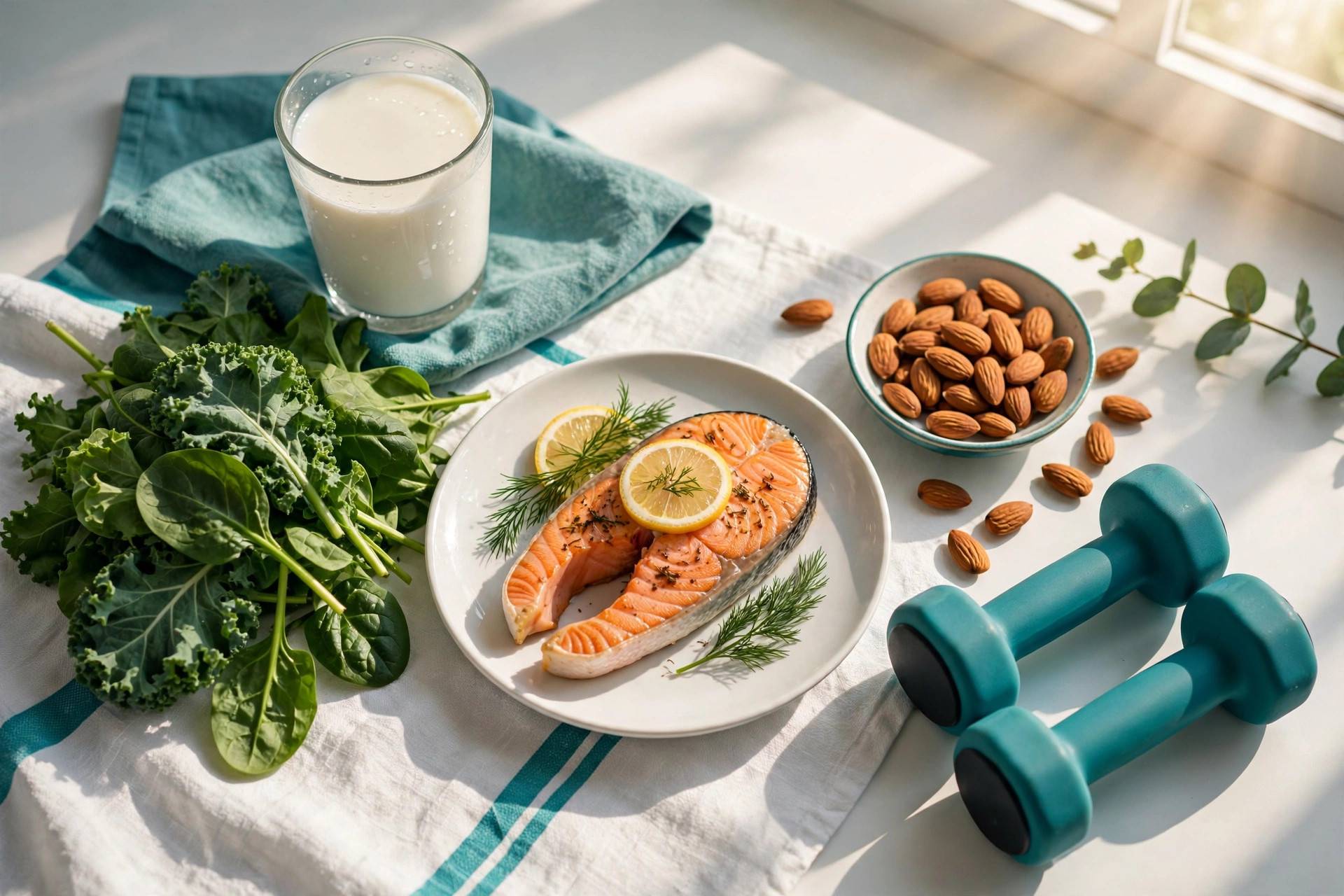
Pillar 1 — Calcium: 1,000–1,200 mg/day. Best sources: dairy, fortified plant milks, sardines with bones, tofu, leafy greens, almonds. Pillar 2 — Vitamin D: helps absorb calcium; sunlight + fatty fish + fortified foods; many adults are deficient — ask your doctor about testing. Pillar 3 — Exercise: weight-bearing (walking, dancing, stair climbing) + resistance (weights, bands) — aim for 30 min most days. Pillar 4 — Lifestyle: don't smoke, limit alcohol, maintain healthy weight.
What Are the Best Exercises for Bone Density?
Weight-bearing: brisk walking, dancing, hiking, tennis. Resistance: dumbbells, resistance bands, bodyweight (squats, push-ups). Balance: tai chi, yoga — prevents the falls that cause fractures. Avoid high-impact if you already have osteoporosis — ask your doctor.
What Are the Treatment Options?
Brief overview, always doctor-directed: bisphosphonates (slow bone breakdown), hormone-related therapies (postmenopausal), bone-building medications (stimulate new bone, for higher-risk patients), calcium/vitamin D optimization. Treatment is long-term; never start/stop on your own.
Frequently Asked Questions
Q: Can osteoporosis be reversed?
A: Bone loss can be slowed, stopped, partially reversed with treatment — but not back to youthful density. Prevention beats rebuilding.
Q: When should I get a bone density test?
A: 65 for women, 70 for men — earlier with risk factors (early menopause, steroids, prior fracture, low weight). Don't wait if you notice early signs.
Q: Does walking really help?
A: Yes — weight-bearing exercise; brisk walking maintains hip/spine density. Consistency is what counts.
Q: Only a women's disease?
A: No — men develop it later (70+) and get screened less, so it goes undetected longer.
Q: Osteopenia — can I avoid osteoporosis?
A: Often yes — the four pillars can stabilize density. Some need medication if fracture risk is high.
Q: Supplements vs food calcium?
A: Food preferred (better absorption + companion nutrients). Supplements are backup — discuss dose with your doctor.
Sources & References
- Bone Health and Osteoporosis Foundation
- NIA (NIH) — Osteoporosis
- Mayo Clinic — Osteoporosis
- Cleveland Clinic — Osteoporosis
- CDC — Osteoporosis
Written by Putri PD. Last updated: October 2026.