
Healthy Meal Prep for Busy Weekdays
Key Takeaways
- Meal prep works because it removes the daily decision: when a balanced meal is already waiting, the busy-weekday scramble gets much easier.
- Food safety sets the schedule. According to the U.S. Department of Agriculture (USDA) Food Safety and Inspection Service (FSIS), most cooked leftovers keep for 3 to 4 days in the refrigerator at 40°F or below, so plan two shorter prep sessions per week rather than one giant one.
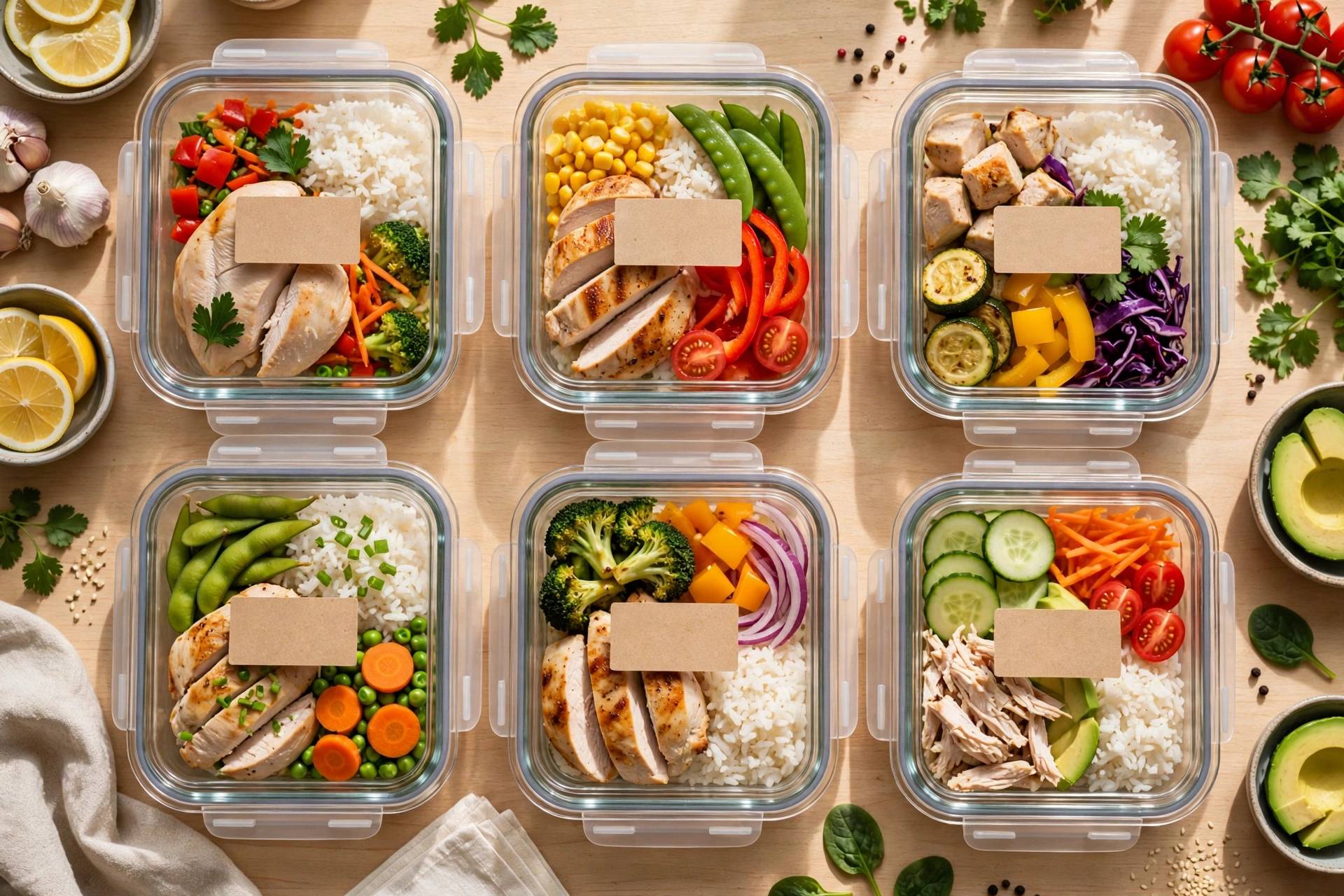
- Build each box around the USDA MyPlate idea: about half fruits and vegetables, a quarter grains, a quarter protein, and dairy on the side.
- Cook components, not just complete meals, so you can mix and match through the week without eating the same lunch five days in a row.
- Label every container with the cooking date, refrigerate within two hours, and reheat leftovers to 165°F.
Why Meal Prep Helps on Busy Weekdays
Weekday eating usually fails for logistical reasons, not for lack of good intentions. After a long day, the gap between feeling hungry and having food ready is when the easiest option wins. That option is often whatever can be ordered fastest or grabbed with the least effort. Meal prep closes that gap in advance. When lunch is already portioned in the refrigerator, the decision is made before hunger and tiredness get a vote.
There is also a planning benefit that goes beyond any single meal. Sitting down once or twice a week to choose meals, write a shopping list, and cook in batches turns five separate daily cooking sessions into one or two focused ones. That frees up weeknights, reduces the number of shopping trips, and makes it easier to buy ingredients in sensible quantities rather than picking up extras on impulse.
Meal prep does not require a perfect system or an entire Sunday lost to the kitchen. A workable version can be as simple as cooking a double batch of dinner and packing the extra portions for lunch the next day. The goal is not to prepare every bite you will eat all week. It is to make the healthy choice the easy choice on the days when time is shortest.
Food Safety Basics: The Rules That Shape Your Schedule
Food safety is the least glamorous part of meal prep, and it is the part that matters most. The storage rules below come from the U.S. Department of Agriculture (USDA) Food Safety and Inspection Service (FSIS), and they directly determine how far ahead you can cook.
According to USDA FSIS guidance, most cooked leftovers — including cooked meat and poultry dishes, soups, stews, egg dishes, cooked rice and pasta, and cooked vegetables — keep for 3 to 4 days in a refrigerator kept at 40°F or below (USDA FSIS guidance, summarized by Wellstockd). Frozen leftovers keep much longer for quality, generally around 2 to 3 months for most cooked dishes, while food held continuously at 0°F stays safe indefinitely (USDA FSIS guidance, summarized by Wellstockd).
Three habits make those time limits easy to respect:
Refrigerate quickly. Perishable food should go into the refrigerator within two hours of cooking, or within one hour if the room temperature is above 90°F (FoodSafety.gov guidance, summarized by Usable Nutrition). Divide large pots of soup or stew into shallow containers so they cool faster instead of leaving one deep pot to cool slowly in the middle.
Label everything with the date. A piece of masking tape and a marker removes all guesswork. If a container was cooked on Monday, write "Mon" on it, and treat Thursday as its last day. The USDA's plain advice for leftovers past the window is simple: when in doubt, throw it out, because you cannot see, smell, or taste most bacteria that cause foodborne illness (USDA recommendations, summarized by Marshfield Clinic).
Reheat thoroughly. Leftovers should be reheated to an internal temperature of 165°F, checked with a food thermometer rather than guessed (FoodSafety.gov guidance, summarized by Usable Nutrition). Soups, sauces, and gravies should be brought to a rolling boil.
The practical consequence of the 3-to-4-day rule is that a single Sunday cook-up cannot safely cover Friday lunch. The framework below is built around that fact: cook twice a week, and freeze anything you will not eat within four days.
A Simple Weekly Framework
You do not need a complicated rotation. A framework with two cook sessions and one midweek refresh covers most weeks.
Step 1: Pick three or four base meals. Choose meals that share ingredients and reheat well: a grain bowl, a soup or stew, a tray of roasted vegetables with a protein, and a pasta or noodle dish. Repeating a few reliable meals is a feature, not a failure — it keeps shopping simple and cooking fast.
Step 2: Write the list from the meals, not from memory. Check what you already have, then list only what the chosen meals need. Shopping from a list reduces duplicate purchases and forgotten ingredients, both of which quietly add cost.
Step 3: Cook in one focused session. A typical session runs about two hours and covers the first half of the week. Start the longest-cooking item first, such as grains or a stew, and prepare vegetables and proteins while it cooks. Portion food into individual containers as soon as it has cooled enough to handle, rather than storing one large container you will repeatedly open and close.
Step 4: Split fridge and freezer on day one. Anything meant for days one through four goes in the refrigerator. Anything meant for later in the week goes straight into the freezer while it is still fresh, not on day four when it is already at the edge of its window. Move a frozen container to the refrigerator the night before you plan to eat it so it thaws safely.
Step 5: Refresh midweek. A short second session, often on Wednesday evening, cooks the second half of the week and uses up any remaining fresh ingredients. This is also the moment to check dates on the refrigerator containers and discard anything past its window.
Building a Balanced Plate
A container full of a single food is convenient but rarely balanced. The USDA's MyPlate model offers a simple visual guide: the agency describes five food groups — fruits, vegetables, grains, protein, and dairy — and recommends filling about half the plate with fruits and vegetables, with the remaining half split between grains and protein and a serving of dairy on the side (USDA MyPlate guidance, via USDA Agricultural Research Service). The same guidance recommends making at least half of your grains whole grains.
Applied to a prep container, that looks like this:
- Half vegetables and fruit: roasted broccoli, carrots, and peppers; a side salad; or a piece of fruit for later. Variety matters more than any single "superfood," so rotate colors and types through the week.
- A quarter grains or starchy foods: brown rice, quinoa, whole-wheat pasta, oats, or potatoes. These store and reheat well, which makes them ideal prep staples.
- A quarter protein: chicken, fish, eggs, beans, lentils, tofu, or tempeh. Plant proteins such as beans and lentils are especially useful for prep because they are affordable, filling, and reheat evenly.
- Dairy or a fortified alternative on the side: yogurt, milk, or cheese, kept separate from the heated container so textures stay pleasant.
You do not need to hit these proportions perfectly at every meal. The plate is a planning aid, not a test. If one lunch is lighter on vegetables, a vegetable-rich dinner can balance the day.
Saving Time and Money Without Cutting Corners
Meal prep saves money mainly by reducing waste and impulse spending, not by requiring special equipment or expensive ingredients. A few habits make the biggest difference.
Cook components, not only finished meals. A tray of roasted vegetables, a pot of grains, and a cooked protein can combine into several different meals: a grain bowl one day, a wrap the next, a soup later in the week. Component cooking prevents the boredom that comes from eating identical boxes day after day.
Use frozen vegetables and fruits generously. They are already washed and cut, they keep for months, and they can fill the vegetable half of a plate on days when fresh produce runs out. They also reduce waste, since you use only what you need.
Repeat a base ingredient across meals. If you cook rice on Sunday, plan a rice bowl for Monday and fried-style rice with vegetables later in the week. If you roast a tray of sweet potatoes, use them in a salad and a grain bowl. Fewer distinct ingredients means a shorter shopping list and less leftover waste.
Keep a running list of meals that worked. When a prep week goes smoothly, write down the menu. Over a month or two, you will build a personal collection of reliable weeks you can rotate without rethinking everything from scratch.
Frequently Asked Questions
How long do meal-prepped meals last in the refrigerator?
According to USDA FSIS guidance, most cooked leftovers keep for 3 to 4 days at 40°F or below (USDA FSIS guidance, summarized by Wellstockd). Plan your prep around that window, and freeze anything you will not eat within four days.
Can I prep a full week of meals in one session?
You can cook a full week of food in one session, but you should not store it all in the refrigerator. Refrigerate what you will eat within 3 to 4 days and freeze the rest on day one, then thaw portions in the refrigerator the night before you need them.
What containers work best for meal prep?
Shallow, airtight containers with tight-fitting lids work best. Shallow containers cool food faster, airtight lids slow moisture loss and prevent odors from moving between foods, and clear containers make it easy to see what is inside. Label each one with the cooking date.
Do I have to eat the same meal every day?
No. Cooking components — grains, proteins, and vegetables stored separately — lets you combine them differently across the week. Two or three base ingredients can produce several distinct meals, which makes the week far less repetitive.
Is it safe to meal prep rice?
Yes, with the same rules as other cooked foods. Cool rice quickly, refrigerate it within two hours of cooking, eat it within 3 to 4 days, and reheat it to 165°F. Do not leave cooked rice sitting at room temperature for extended periods.
This article is for general information only and is not medical advice. Talk to a healthcare professional before making changes to your diet or health routine.
By Putri PD